Science dissemination - Wydział Filozoficzny

The IDUJ program funds for 2026 have been fully allocated.
As a result, the call for new applications has been suspended.

 
The rules for project implementation and spending the funds remain unchanged (a short overview is provided below). In the case of projects covering both semesters, the release of the second part of the funding depends on the full use of the funds planned for the first semester. The use of the first part of the funding will be verified at the end of June. If any funds become available at that time - due to not using the first part or not starting the second - additional projects may be funded from among the applications already submitted that have not yet received support, or the call may be reopened.

***

In the current year, the IDUJ budget is divided into two semesters. Funds planned for the first semester should be spent by the end of June (and obligated, with ‘obligo’ created, by the end of May), while funds planned for the second semester should be spent by the end of October (and obligated by the end of September).
 
Note: Receiving a funding decision does not mean that an obligation (‘obligo’) has been created. An obligation is created for specific expenses at the request of the project manager. Only funds that are supported by appropriate documents - such as an invoice, travel request, contract, accounting note, etc. - may be obligated.
 
In the case of projects covering both the first and second semesters, their schedule should be divided accordingly. It will not be possible to transfer funds from the first to the second semester.
 
Due to the limited budget for 2026 and the intention to support as many staff members as possible, there is a limit of PLN 50,000, which is the total amount that each eligible person may apply for across all ID UJ calls this year.
 
***

More detailed information can be found in the staff mailing. If you have any questions, please feel free to contact us.

***

As part of the Excellence Initiative, there is a possibility of financial support for activities in the field of popularization of science. If you are interested, please contact Marta Maj, PhD (marta.maj@uj.edu.pl).

You can find information about the dissemination of scientific activities at the Faculty below.

Dr Barbara Ostafińska-Molik oraz dr hab. Anna Gaweł, prof. UJ - badaczki z Instytutu Pedagogiki na Wydziale Filozoficznym Uniwersytetu Jagiellońskiego zbadały, różnice i podobieństwa w poziomie rozwinięcia wspomnianych „sił” jako wymiarów zdrowia społeczno-emocjonalnego wśród studentek i studentów. 
W badaniach zastosowano metodę sondażu diagnostycznego oraz ankietę internetową CAWI. Grupa badawcza liczyła 491 osób. Wyniki opublikowano w Lubelskim Roczniku Pedagogicznym https://doi.org/10.17951/lrp.2025.44.1.105-122
aktualności instytut pedagogiki publikacje popularyzacja

Zestresowany jak student? Receptą: wiara w siebie, poczucie wspólnoty, optymizm

03.06.2025
Studenci często doświadczają wysokiego poziomu stresu. W procesie radzenia sobie z nim najbardziej efektywne okazują się poczucie wspólnoty i przynależności oraz umiejętność spojrzenia na stres z innej perspektywy wśród kobiet, a wiara w siebie wśród mężczyzn - pokazują badaczki Instytutu Pedagogiki Wydziału Filozoficznego.
Read More o Zestresowany jak student? Receptą: wiara w siebie, poczucie wspólnoty, optymizm
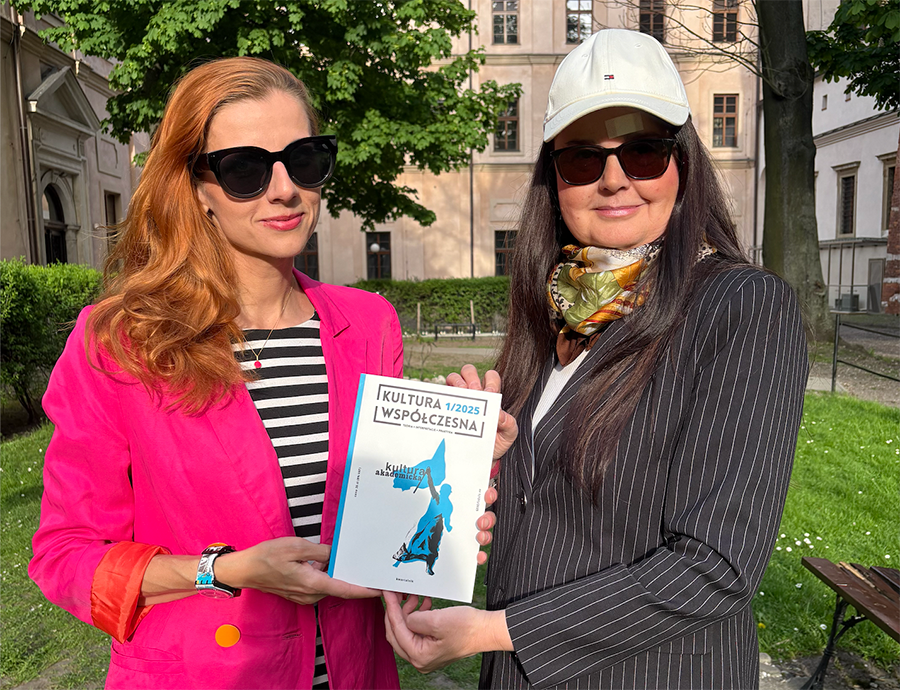
Analizy przejawów kulturowej prekognicji w tych dwóch serialach na łamach pisma Kultura Współczesna – Kultura Akademicka omówiły badaczki Instytutu Socjologii na Wydziale Filozoficznym Uniwersytetu Jagiellońskiego - dr hab. Małgorzata Bogunia-Borowska, prof. UJ oraz dr Justyna Kopczyńska.
aktualności instytut socjologii publikacje popularyzacja

Artistic vision of the future or inspiration for science? What is cultural precognition?

02.06.2025
Autonomous vehicles, assistive robots, video calls, and smartwatches are technological conveniences that many of us use today. Once, they were merely bold artistic visions that inspired scientists and engineers. These manifestations of so-called cultural precognition have been analyzed by sociologists from the Faculty of Philosophy at the Jagiellonian University.
Read More o Artistic vision of the future or inspiration for science? What is cultural precognition?
Chiny i Tajwan: dwie drogi do dekarbonizacji
aktualności instytut socjologii publikacje popularyzacja

China and Taiwan: Two Paths to Decarbonization

30.05.2025
Decarbonizing industry requires not only technological progress but also the inclusion of social aspects, perceptions of risk, and visions of the future. Two distinct approaches to decarbonization in China and Taiwan have been analyzed by Dr. Tadeusz Rudek from the Institute of Sociology at the Faculty of Philosophy of the Jagiellonian University, where he leads the research lab Capturing Invisible.
Read More o China and Taiwan: Two Paths to Decarbonization
Współczesny Arystoteles
aktualności instytut filozofii publikacje popularyzacja

Not an expert, but a guide. Who is the modern sage?

22.05.2025
While experts provide knowledge and enable understanding in specific fields, sages act as guides through reality, offering a broader perspective in the face of the atomization of science and the flood of information. A new, functional concept of theoretical wisdom has been presented by Dr. Dominik Jarczewski of the Institute of Philosophy of the Faculty of Philosophy of the Jagiellonian University.
Read More o Not an expert, but a guide. Who is the modern sage?
Poczucie sensu kluczem do dobrego życia. Czy szkoły mogą nauczyć nas szczęścia? Badania w Instytucie Pedagogiki Wydziału Filozoficznego UJ.
aktualności instytut pedagogiki publikacje popularyzacja

The sense of meaning as the key to a good life. Can schools teach us happiness?

16.05.2025
Positive emotions, a sense of life’s meaning, and well-being can be a fundamental human strength that should be taken into account in research. The results of such analyses can then be applied in pedagogical practice, for example, when designing educational methods," argue educators from, among others, the Institute of Pedagogy at the Faculty of Philosophy of the Jagiellonian University.
Read More o The sense of meaning as the key to a good life. Can schools teach us happiness?